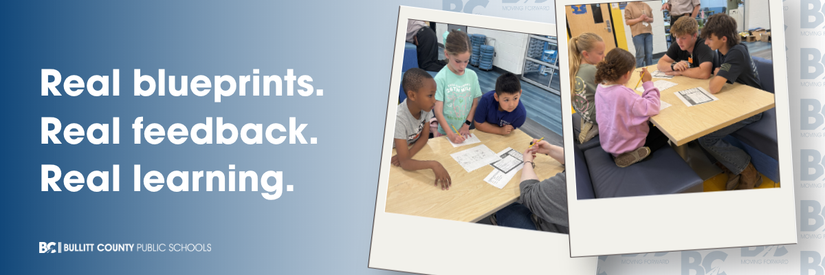
What happens when third graders become engineers? At Old Mill Elementary, students are finding out, and they have expert partners helping them along the way. Third grade students are tackling force and motion through a hands-on engineering challenge: designing and building their own putt-putt golf holes. Students from the ATC are serving as feedback partners, bringing real technical expertise to the collaboration and helping younger students sharpen their designs before construction begins.
The project connects directly to the third-grade science curriculum's study of force and motion, while also integrating math concepts including area and perimeter. Before any building began, OME students identified the specific challenges they expected to face, such as the best way to attach materials and how to engineer smooth curves into their designs. That kind of forward thinking, asking hard questions before the work starts, set the foundation for meaningful, purposeful learning.
With their questions in hand, OME students moved into small group work to develop detailed blueprints for their designs. Each group considered dimensions, materials, and the physics behind their planned courses. Then came the feedback round: ATC students reviewed the blueprints and offered targeted, specific input based on their own technical experience. The exchange gave third graders access to the kind of real-world expertise they could not get from a textbook, and it pushed both groups to communicate thoughtfully and think critically about the task at hand.
"This project gave students a genuine reason to collaborate and communicate," said Kimberly Reibert, Instructional Coach at Old Mill Elementary. "When third graders have to explain their design decisions to older students and actually incorporate the feedback they receive, they are practicing skills that go far beyond the classroom."
The Putt-Putt Partnership demonstrates multiple BCPS Graduate Profile competencies at work.
Working in small groups to develop their designs and incorporate feedback, students showed what it means to be a Productive Collaborator. They listened to different perspectives, built on each other's ideas, and made adjustments that strengthened their final products.
Both OME and ATC students exercised the skills of an Effective Communicator throughout every stage of the project. Third graders learned to clearly explain their design decisions and articulate the specific challenges they expected to face. ATC students practiced translating technical knowledge into feedback that was useful and actionable for a younger audience.
Students at both schools demonstrated the commitment of a Mastery Learner by applying content knowledge to real construction challenges. For third graders, that meant bringing math and science standards to life through a tangible project. For ATC students, it meant drawing on what they know to support someone else's growth.
Students also showed the problem-solving mindset of an Innovative Problem Solver. By identifying design challenges before they encountered them and developing creative solutions within the constraints of their materials, students practiced exactly the kind of anticipatory thinking that real-world builders and engineers rely on.
Through the cross-school partnership itself, students embodied the spirit of a Community Contributor. By sharing knowledge, offering support, and investing in each other's success, students at both schools built something larger than a putt-putt course: a genuine learning community.
This collaboration also reflects core BCPS values. Students Matter Most was the organizing principle of every design conversation and feedback session, and Proactive Innovation drove educators to build a learning experience that connected curriculum to authentic, real-world application in a way that challenged students to grow.
As BCPS continues Moving Forward, projects like the Putt-Putt Partnership show what authentic learning looks like in practice. When students are given real problems to solve, real partners to work alongside, and real stakes attached to their work, learning becomes more than preparation for the future. It becomes the future, happening right now, one design at a time.